






Factsheet
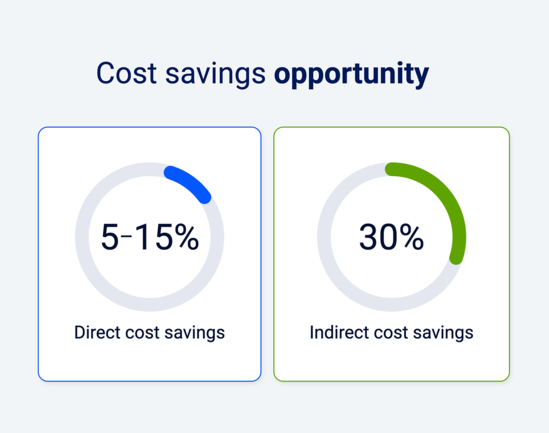
Companies can cut contingent workforce costs by 5 to 15% directly, and up to 30% indirectly by implementing a vendor management system (VMS).
In today’s intensely competitive market, companies are engaging external talent to boost workforce agility. Industry analysts report that external workers have grown from 17% of the average company’s total workforce in 2009 to nearly half today.
Controlling the costs of this growing workforce is a significant challenge for HR, procurement, and talent acquisition professionals. A VMS has become the baseline for managing this challenge and preventing costs from spiraling out of control. To see how, it's essential to understand all the cost components involved.
Managing direct and indirect costs
When program managers consider controlling external labor costs, their first consideration is usually how to reduce hourly rates. While billing rates are important, they are only one factor affecting contingent labor costs. To control or optimize contingent workforce costs, managers must address the challenge holistically. This starts with understanding direct and indirect costs.
Direct cost factors
These are the costs you negotiate directly with staffing suppliers (the price of the labor itself):
- Rate cards
- Markup visibility
- Shift and overtime hours
- Volume discounts
- Payment terms
Indirect cost factors
These are the hidden costs baked into how the program runs (the time and effort spent managing it, not the pay rate itself):
- Data transparency
- Standardization templates
- Approval steps
- Candidate selection
- Processing hours
Margins
- Variations in sourcing channels
- Cost avoidance
- Overstaffing vs. understaffing
Onboarding
- Candidate review processing
- Supplier negotiations
- Invoicing
Direct cost savings can be achieved by reducing hourly or daily rates and lowering statement of work (SOW)-based project costs. They can also come from volume discounts and early payment reductions negotiated with staffing suppliers.
Significant increases in process efficiency and automation, from approval processing to candidate sourcing, onboarding, reporting, and various cost avoidance measures, can help achieve indirect cost savings.
All of this (savings, control, optimization) comes down to one thing: the VMS’s ability to collect and analyze your contingent workforce data.
Effective cost avoidance techniques can include:
- Shifting work to a lower-cost location
- Leveraging workforce planning and automating low-value tasks
- Rationalizing your supplier base to high-performing or lower-margin vendors

Unlock the power of your workforce data
Armed with data about every worker, every supplier, and every assignment within your VMS, you can answer these questions:
- Are you paying market rates for your contingent workers?
- Are your hiring managers paying staffing agencies based on negotiated rate cards?
- Which of your suppliers are your best performers, and which are not?
- Which of your workers may soon become available for an open assignment?
- Are your rates consistent across your business?
- Are all of you contingent workers being classified correctly?
Discover how you can save with a VMS
What does that saving actually look like in practice? Find out how much you can save with Beeline VMS technology.